Do You Need More Than 1Gbps Broadband in Singapore?
For almost all households, 1Gbps home broadband is more than enough — even with several people streaming 4K, video-calling and gaming at once. Higher tiers like 2Gbps or 10Gbps mainly help very large households, heavy uploaders or specific wired setups. In practice your Wi-Fi and devices, not the plan, are usually the limit.
For almost every home in Singapore, 1Gbps broadband is already more than enough. The jump to 2Gbps, 5Gbps or 10Gbps looks impressive, but most households never use even a fraction of 1Gbps at once — and when a connection feels slow, the cause is usually Wi-Fi or an old device, not the fibre tier.
What actually uses bandwidth
Everyday activities use far less than the headline suggests:
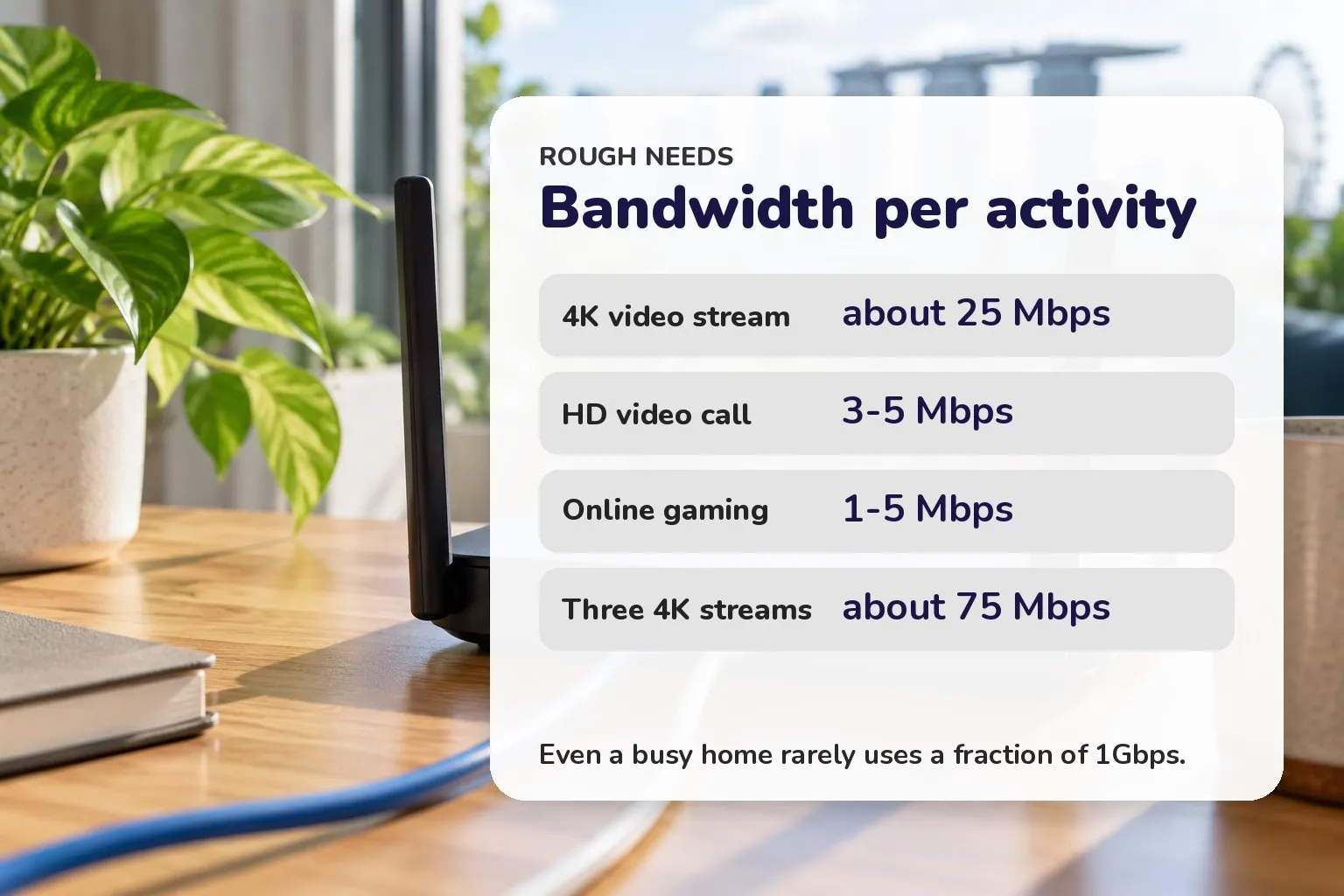
Rough bandwidth each activity needs.
| Activity | Rough bandwidth it needs |
|---|---|
| 4K video stream | ~25 Mbps |
| HD video call | ~3–5 Mbps |
| Online gaming | ~1–5 Mbps (low data, needs low latency) |
| Large file / game download | As fast as the link allows (bursty) |
Add it up: three people watching 4K at once is about 75 Mbps — under 10% of a 1Gbps line. Even a lively household with streaming, calls, gaming and downloads rarely sustains more than a couple of hundred Mbps.
Your Wi-Fi is usually the real limit
Here’s the catch most upgrade pitches skip: the devices in your home — phones, laptops, TVs — nearly all connect over Wi-Fi, and Wi-Fi speeds depend on the router, distance, walls and how old the device is. A phone in a back bedroom may only see a few hundred Mbps regardless of whether your plan is 1Gbps or 10Gbps. Paying for 10Gbps changes nothing if your Wi-Fi tops out well below 1Gbps.
To actually benefit from more than 1Gbps you generally need:
- a router with multi-gig ports (2.5GbE or faster),
- devices connected by wired Ethernet, and
- enough simultaneous demand to use the headroom.
Without those, the extra speed sits unused.
When a higher tier does help
A tier above 1Gbps can be worth it if you:
- run a large shared household where many heavy users overlap,
- regularly upload large files (creators, remote backups) and your plan offers higher upload speeds,
- have a wired setup (NAS, workstation, server) that can genuinely move multi-gig traffic.
If none of these apply, the money is better spent elsewhere.
Spend it on coverage instead
For most homes, better Wi-Fi coverage improves real-world speed far more than a higher plan tier. A mesh Wi-Fi system spreads a strong signal across a larger or multi-level flat, so every room gets close to the speed you pay for. The ISP’s bundled router is often fine for a small flat; a mesh upgrade helps bigger homes. Weigh buying your own mesh against the ISP’s option, and factor it into the effective cost when comparing broadband plans.
Bottom line
Pick 1Gbps unless you have a specific, hardware-backed reason to go higher. Then put any saved budget toward Wi-Fi coverage. If you are also reviewing your mobile line, see whether bundling mobile and broadband saves money. Confirm current plan details on the provider’s own page before signing up.
Sources
- IMDA — telecommunication services and consumer information — Infocomm Media Development Authority (as of October 2026)
- IMDA — Nationwide Broadband Network — Infocomm Media Development Authority (as of October 2026)