Fixed vs Discount-Off-Tariff Electricity Plans
A fixed-price plan locks one rate for the whole contract; a discount-off-tariff (DOT) plan gives a set discount off the quarterly regulated tariff, so your rate moves with it. Fixed suits people who want certainty and expect the tariff to rise; DOT suits people who want to always pay below the tariff and don't mind quarterly changes.
Singapore’s Open Electricity Market offers two standard plan types, and the choice between them comes down to one question you cannot answer with certainty: will the regulated tariff rise or fall during your contract? A fixed-price plan is a bet that it rises; a discount-off-tariff plan guarantees you stay below the tariff wherever it goes.
How each one works
- Fixed Price Plan — you pay one constant rate (e.g. a set cents/kWh) for the whole contract. Because the regulated tariff is reviewed every quarter, your fixed rate can end up higher or lower than the tariff at different points.
- Discount Off the Regulated Tariff (DOT) — you get a fixed percentage discount off the tariff. Your rate changes every quarter with the tariff, but always stays a set amount below it.
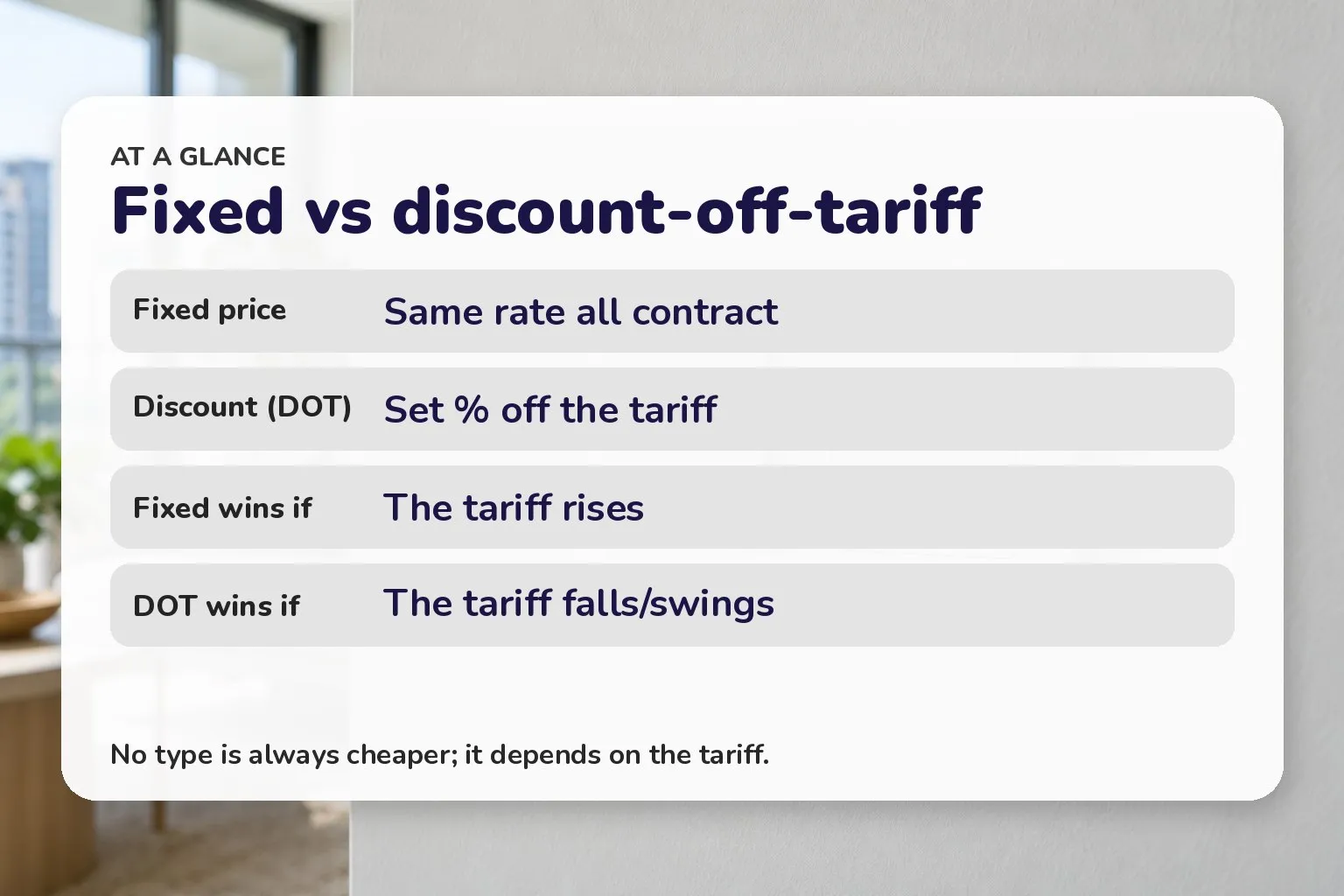
The two standard plan types at a glance.
| Fixed price | Discount off tariff (DOT) | |
|---|---|---|
| Your rate | Same all contract | Moves each quarter |
| Vs the tariff | Can be above or below | Always below, by the discount |
| Certainty | High — you know the rate | Lower — rate changes quarterly |
| Best if you think | Tariff will rise | Tariff will fall or swing |
Why the tariff level matters
Because a DOT plan tracks the regulated tariff, and a fixed plan is judged against it, the tariff’s direction decides which plan wins. And the tariff moves a lot. Here is the recent quarterly regulated tariff (before GST):
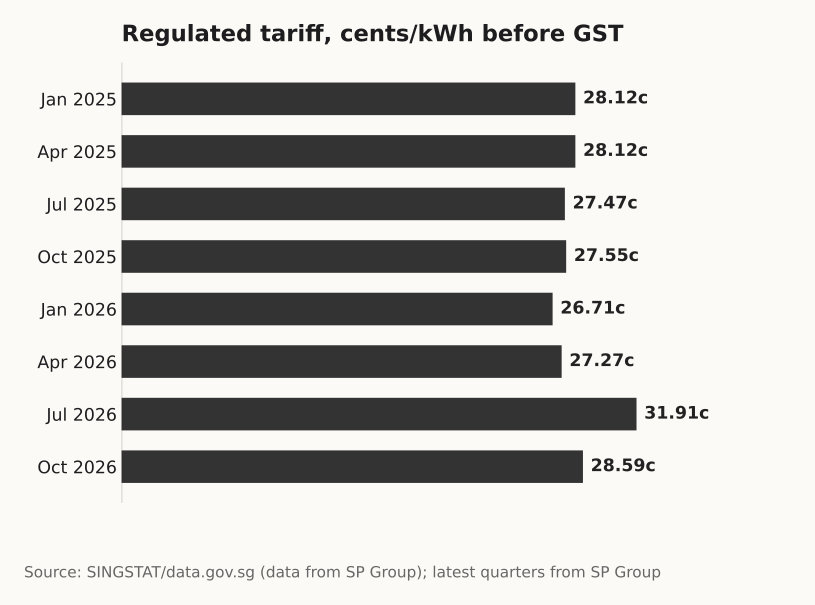
Singapore regulated low-tension domestic tariff by quarter, before GST. Source: SINGSTAT via data.gov.sg (data from SP Group); Jul–Oct 2026 from SP Group releases.
The regulated tariff drifted down through 2025 and into early 2026, then jumped sharply in the third quarter of 2026 before easing again for the current quarter. If you had locked a fixed rate in early 2026 below that spike, you would have come out ahead that quarter; if the tariff keeps falling, a DOT plan quietly follows it down while a fixed rate stays put.
Who each plan suits
Choose fixed price if you value a predictable bill, you are budgeting tightly, or you believe the tariff is more likely to rise than fall over your contract. The downside: if the tariff drops below your locked rate, you pay more than tariff customers.
Choose DOT if you want to always pay below the regulated tariff and you are comfortable with your rate changing each quarter. The downside: when the tariff spikes, your rate rises too (just by less than the tariff).
There is no guaranteed winner
No retailer or guide can tell you which will be cheaper, because that depends on future tariff moves no one controls. Honest framing: pick based on your tolerance for a changing bill, not on a promise that one type “always saves more”. The regulated tariff for 1 Oct–31 Dec 2026 is 28.59 cents/kWh before GST — use it as your benchmark, and remember it swung from 27.27 (Q2 2026) up to 31.91 (Q3 2026) and back down, so a lot can change within a single two-year contract.
Before you commit
Read the plan’s Fact Sheet, check the contract length, any security deposit, early-termination fee and auto-renewal terms. Our how to choose an electricity retailer checklist walks through each one, and the Open Electricity Market explainer covers how switching works. Always confirm the current tariff and plan rates on SP Group’s and the retailer’s own pages first.
Sources
- FAQs: Price Plans and Packages — Open Electricity Market (Energy Market Authority) (as of October 2026)
- Consumer Advisory: Signing Up with Retailers — Open Electricity Market (Energy Market Authority) (as of October 2026)
- Electricity Tariff Information — SP Group (as of 1 October 2026)
- Electricity Tariff dataset — SINGSTAT via data.gov.sg (source: SP Group) (as of October 2026)