How to Keep Your Number When Switching Telco in Singapore

Your new telco ports the number for you — you never contact the old one. Keep the existing line active, clear any bills and finish any contract, then sign up and choose 'port in'. It is usually free and done within one working day.
On this page9 sections · tap to jump
Switching mobile plans in Singapore does not mean giving up the number everyone already has for you. Under the full mobile number portability framework, your new telco does all the work: you sign up, choose “port in”, and it coordinates with your old provider behind the scenes. You never call the old telco to “release” the number. Get three things right first — keep the old line active, settle any outstanding bill, and make sure you are out of contract — and the switch is usually free and completes within one working day.
This guide walks through exactly who does what, how long it really takes, the fees that can creep in, and how to switch with little or no gap in service.
How number porting actually works
Mobile number portability is recipient-led. The provider you are moving to initiates the port on your behalf once you sign up and select the option to keep your existing number — labelled “port in”, “Keep my existing number” or similar at checkout. It then verifies your details, works with your current (donor) provider, and switches the number over.
That is why every provider says the same thing: do not cancel your old line yourself. It must stay active right up to the moment the port completes, or the number can be lost. StarHub puts it bluntly — “DO NOT cancel your current mobile line! It must be active until the switch is done” — and SIMBA, Singtel and GOMO all require the existing line to be live during the process.
Your pre-port checklist
Before you sign up with the new provider, line up these so the request is not rejected:
- Keep the old line active. No disconnection, no cancellation until the port is done.
- Match your details exactly. The name and ID (NRIC/FIN) you register with the new telco must be identical to what the donor telco holds. SIMBA warns that a mismatch is the most common reason a port fails.
- Clear outstanding bills. Singtel’s hi! plan requires an “active postpaid mobile line with no outstanding payments”; GOMO says the same.
- Check you are out of contract. If the old line is still within its minimum term, the donor telco can charge an early-termination fee — the new telco cannot waive that.
- Have your new SIM or eSIM ready. Physical SIMs add delivery time; an eSIM can be installed immediately.
How long porting takes (and the no-downtime trick)
The regulated standard is fast: operators “are required to complete the porting of mobile telephone numbers within one working day” (MDDI). In practice StarHub says a port is “usually done in a day”.
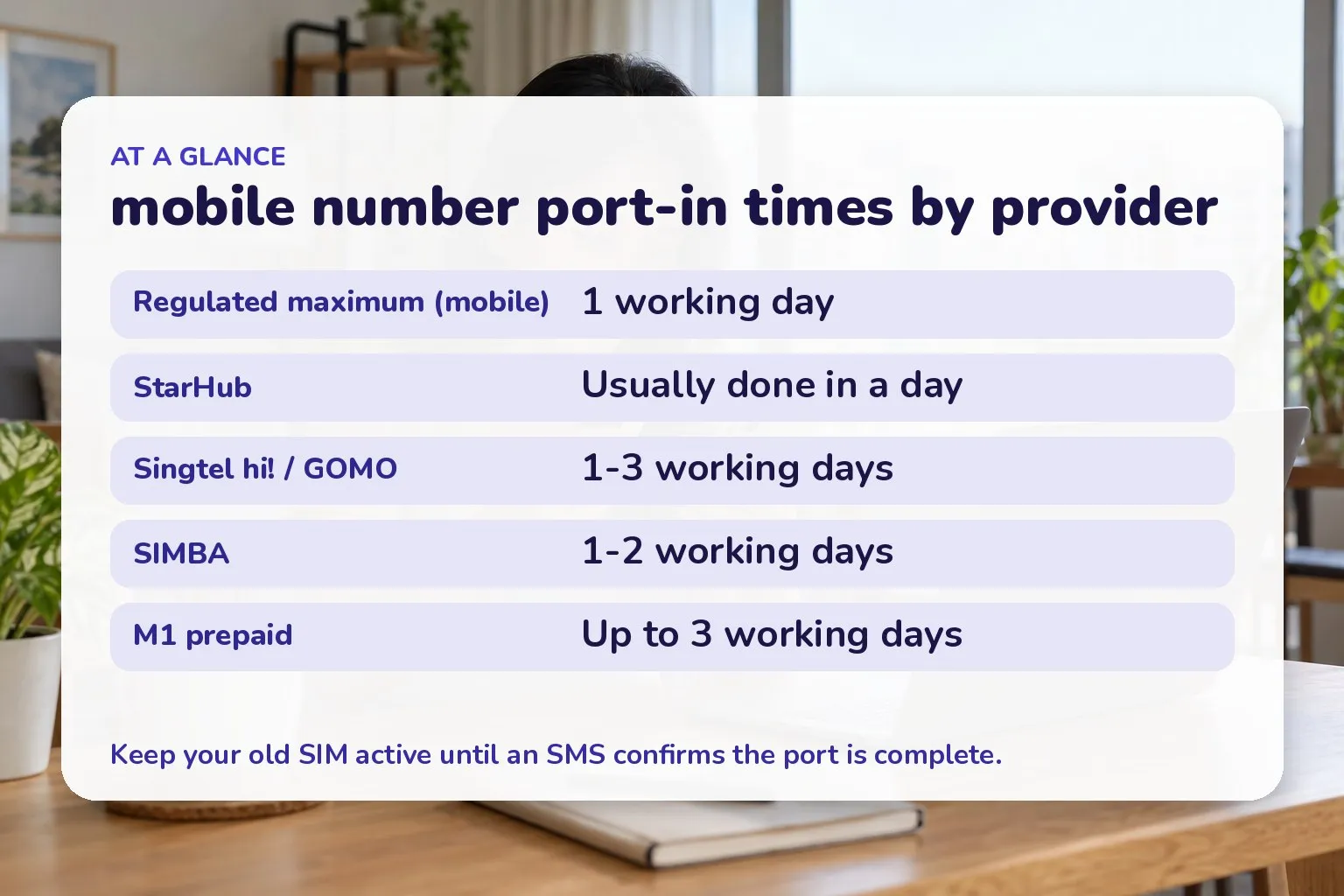
Quoted port-in windows; one working day is the regulated maximum.
Individual providers quote a wider safety window, though, so plan for a day or two:
| Provider | Quoted port-in time | Cover while porting |
|---|---|---|
| StarHub | Usually done in a day | Use old SIM until notified |
| Singtel (hi!) | 1–3 working days | Temporary number assigned |
| GOMO | 1–3 working days | Temporary GOMO number |
| SIMBA | 1–2 working days | Keep using current service |
| M1 (prepaid) | Up to 3 working days | Two SMS status updates |
The clever part: providers like Singtel’s hi! plan and GOMO give you a temporary number to use immediately, then do a “seamless switch” to your real number when the port lands — so your phone works the whole time. With a physical SIM you simply keep the old SIM in until an SMS tells you to swap; with an eSIM the handover can take minutes.
What porting costs
For most consumer plans, porting your number is free. Singtel’s hi! plan states “transferring your number to hi! Plan is completely free”, and StarHub ports “for FREE” during online sign-up. There is no government porting fee.
Two costs can still appear, and neither is the porting itself:
- Early-termination charges from your old telco if you leave mid-contract. These belong to your existing contract, not the port.
- Final usage charges. You remain the outgoing operator’s customer, and are billed under that contract, until the number actually ports — Singtel’s number-portability form makes you “responsible for all charges incurred up to the date and time” of the port.
Prepaid, eSIM and name-mismatch cases
- Prepaid lines can port, with conditions. M1 lets you port a prepaid number out “while your SIM card is still active — within the first 30 days of activation”, and the port-in takes up to three working days. SIMBA accepts prepaid ports at its Service Centres or dealers only, not fully online.
- Prepaid vs postpaid is not interchangeable at some telcos. SIMBA ports a postpaid line onto a SIMBA postpaid plan, and a prepaid line onto prepaid (or its SuperRoam10 plan) in person.
- eSIM makes it faster. Because an eSIM activates digitally, there is no SIM to wait for; see our eSIM guide for what your phone needs.
- Number not under your name? You cannot port it until ownership is transferred to you. GOMO’s advice is to “reach out to your current telco to transfer ownership of your number to you” first.
Does it work with every provider?
Yes. Portability covers the three network operators (Singtel, StarHub, M1), SIMBA, and every digital sub-brand and MVNO — GOMO, giga, Circles.Life, zero1, VIVIFI and the rest — because they all ride on the same regulated framework. One quirk at StarHub: its Star plan terms require the line being ported in to be “an active postpaid number” registered under the same name, so a prepaid line uses a different path. If you are still deciding where to move, start with our best SIM-only plans comparison.
Porting a home fixed-line number
Home phone numbers portability is a different, slower track. Fixed-line porting must be completed “within five working days” (MDDI), not one. And if you are moving your home number and switching fibre broadband at the same time, expect “at least an additional three working days for the incoming provider to activate fibre services before the number porting process can begin”. If you are also changing broadband, read our companion guide, switching broadband without downtime.
If porting is delayed or rejected
Most failures trace back to the checklist: a name or ID mismatch, an unpaid bill, a line already cancelled, or an existing contract still running. If a port stalls:
- Keep the old SIM in and the old line active — do not cancel it.
- Check the SMS updates; providers send approval/rejection notices (M1 sends two).
- Fix the flagged issue (settle the bill, correct the name) and resubmit through the new telco.
- If it still fails, the new provider raises it with the donor telco; you do not contact the old telco yourself.
FAQ
Who do I contact to port my number — my old or new telco? Only the new one. It initiates and manages the whole port; you never ask the old telco to release the number.
Will my phone stop working during the switch? Usually not. Keep the old SIM active, and many telcos give you a temporary number so you stay connected until the real number switches over.
Is there a fee to keep my number? Porting itself is free on mainstream plans. You may owe your old telco an early-termination fee if you leave mid-contract, plus usage up to the port date.
How long does it really take? One working day is the regulated maximum for mobile; providers quote one to three days to be safe.
Can I port a prepaid SIM? Yes, within each telco’s rules — M1 prepaid only within its first 30 days, and some telcos handle prepaid ports in-store.
Prices, promos and processing windows change, so confirm the current porting steps and any fees on your chosen provider’s own page before you sign up.
Sources
- MDDI — response to PQ on porting of telephone numbers — Ministry of Digital Development and Information (as of October 2026)
- IMDA — Telecommunications Consumers — Infocomm Media Development Authority (as of October 2026)
- StarHub — Switch to StarHub (mobile number porting) — StarHub (as of October 2026)
- Singtel — hi! Plan FAQ (port in or transfer number) — Singtel (as of October 2026)
- SIMBA — How do I switch / port in to SIMBA? — SIMBA (TPG Telecom) (as of October 2026)
- GOMO — Mobile plan FAQ (port in your number) — GOMO (Singtel) (as of October 2026)
- M1 — Prepaid FAQ (porting your number) — M1 (as of October 2026)