Best Mobile Plans for Heavy Data Users in Singapore
For heavy data use, the real choice is between genuinely 'unlimited' plans (Singtel, StarHub) and very high fixed quotas (Simba, M1). Both carry a fair-use limit — judge a plan on what happens when you cross it: throttle, auto top-up or hard stop.
If you stream, game, tether or video-call for hours a day, the plan you want is one that stays fast when you use a lot — not just the one with the biggest number on the banner. In Singapore that comes in two shapes: genuinely unlimited plans (Singtel and StarHub sell these) and very high fixed quotas of several hundred gigabytes (Simba and M1 lean this way). The figures below are approximate, as of October 2026, and move often, so always confirm the current price and terms on the provider’s own page before you sign up.
This is a framework, not a live price table — a stale “cheapest plan” number is worse than none. What matters for a heavy user is less the headline and more the fine print: the fair-use cap, what happens when you cross it, and whether tethering and 5G are included.
True unlimited vs a very high quota
“Unlimited” rarely means infinite. Both Singtel and StarHub advertise unlimited local data on their mid and top SIM-only tiers, but it comes with a Fair Usage Policy — Singtel’s terms, for example, set a high full-speed allowance (up to around 1TB a month on its top tier, approximate as of October 2026) after which speed is reduced to about 1Mbps. StarHub’s unlimited tiers start around S$38/month and Singtel’s unlimited (no-contract) tier is around S$40/month before promotions (about S$36 on its current port-in offer), as of October 2026.
The other camp sells a big fixed bucket instead. Simba, which runs on the TPG network, lists plans from a few hundred up to 800GB per 30-day cycle (roughly S$10–S$25, as of October 2026), and M1’s build-your-own SIM-only plans scale up toward 1TB. For most people these quotas are effectively unlimited — few phone users clear 300GB in a month on mobile data alone.
What happens when you hit the limit
This is the question that actually separates the plans, so ask it before you sign:
| When you cross the cap | What it means for you |
|---|---|
| Speeds are throttled | You stay connected but slower (maps and chat fine, 4K video not) — common on “unlimited” fair-use plans. |
| Auto top-up is charged | You keep full speed but pay for extra data blocks — predictable only if you know the per-GB rate. |
| Hard stop until next cycle | Data cuts off; you must top up manually or wait — rare on heavy-data plans but worth confirming. |
Tethering, 5G and the catches
Three things quietly decide whether a heavy-data plan is as good as it looks:
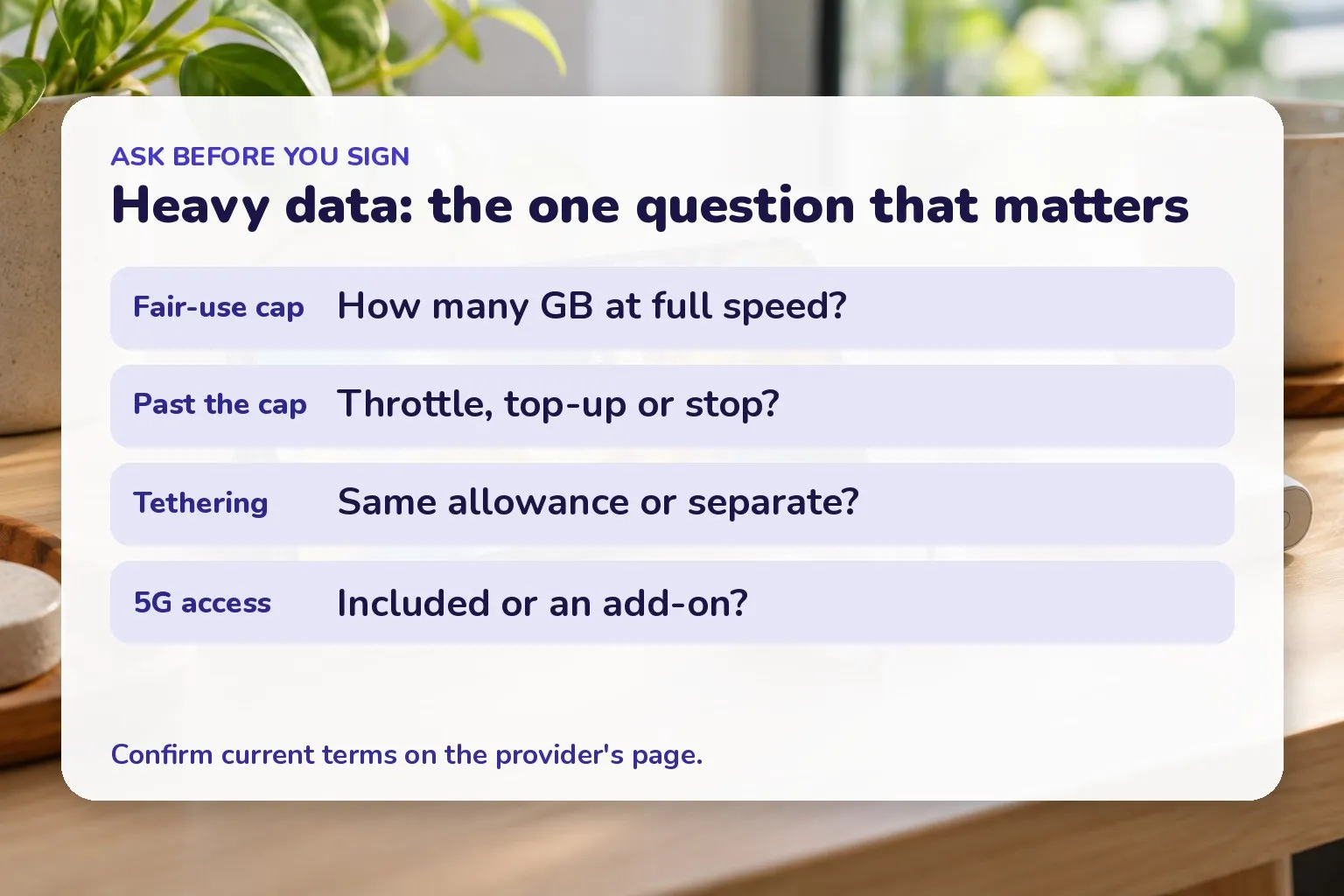
The fine print that decides a heavy-data plan.
- Tethering/hotspot: most Singapore plans let you hotspot from the same allowance, but confirm it is not a separate, smaller bucket — heavy tether users burn data fast.
- 5G access: faster speeds help heavy users, but some cheaper tiers are 4G-only or treat 5G as an add-on. Only pay for 5G if your phone and usual locations actually get it.
- Promo vs long-term price: several plans advertise a low intro rate that steps up after a few months. Judge the plan on the price you will pay long term, not the first-bill price.
Networks and value
Singapore has four mobile network operators — Singtel, StarHub, M1 and Simba — plus MVNOs (virtual operators such as Circles.Life, giga! and CMLink) that lease capacity on one of those networks. All four operators must meet IMDA’s nationwide outdoor 4G standard, so outdoor coverage is broadly similar, but indoor performance and speeds under congestion vary by location. Challenger networks and MVNOs usually give the most data per dollar; the trade-off can be indoor coverage, 5G access or support, so check the network behind an MVNO and test reception on your usual routes.
A simple decision rule
- Find your heaviest recent month from your bills or data-usage screen.
- If that peak is comfortably under ~300GB, shortlist very-high-quota plans — they are usually cheaper.
- If you regularly exceed that, or you hotspot as a home connection, shortlist true unlimited and check the fair-use cap.
- For each shortlisted plan, confirm: fair-use limit, what happens past it, tethering rules, 5G, and the long-term price.
- Prefer no minimum term unless a locked-in tier is clearly cheaper over its full length.
Once you have a shortlist, rank it on effective monthly cost in our SIM-only plan picker. For the broader comparison method, see how to compare SIM-only plans; if you are weighing a bundled phone, read postpaid vs SIM-only; and if you travel often, check how roaming fits in via our eSIM guide.
Prices and allowances change constantly. Always confirm the current figures on the provider’s own page before signing up — and see how we track plan prices for where our numbers come from.
Sources
- Singtel — 5G+ SIM Only plans — Singtel (as of October 2026)
- StarHub — SIM Only plan comparison — StarHub (as of October 2026)
- M1 — 5G SIM-Only (Bespoke) plans — M1 (as of October 2026)
- Simba — mobile plans — Simba (TPG Telecom) (as of October 2026)
- IMDA — telecommunication services and consumer information — Infocomm Media Development Authority (as of October 2026)